

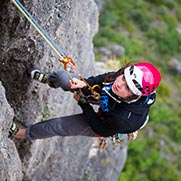
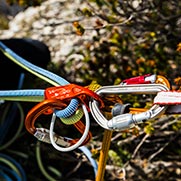
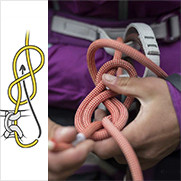



Inspection of anchors on rock, ice or mixed routes.
Fixed anchors on cliffs, icefalls, or in canyons and caves can be worn, corroded, weakened or loose. It is essential to check their condition before use.
Warnings
- Carefully read the Instructions for Use used in this technical advice before consulting the advice itself. You must have already read and understood the information in the Instructions for Use to be able to understand this supplementary information.
- Mastering these techniques requires specific training. Work with a professional to confirm your ability to perform these techniques safely and independently before attempting them unsupervised.
- We provide examples of techniques related to your activity. There may be others that we do not describe here.
The examples below illustrate various ways that anchors can change over time due to use and environmental conditions.
Before using an anchor, remember to check its condition or test it. If doubt remains, replace or back-up the anchor whenever possible. It is never advisable to rely on a single anchor point.
If you notice that all the anchors on a route are worn, it’s probably best to bail off the route. In that case, notify the applicable organizations and/or the person responsible for the anchors.
1. Wear due to use
Gradual or sudden deterioration of equipment caused by cyclic loading during normal use (friction, loads, impacts, handling), may reduce its mechanical or functional performance.
Significant wear, deformation or cracking
Pronounce wear on the rope path can significantly reduce anchor strength. This wear can be seen on the rope’s rub point, e.g. on rappel station quick links or other anchors on the route. Welded rings may also develop cracks in the area around the weld.
Burrs and sharp edges
If the edge of a hanger or piton has burrs or sharp edges, the attachment holes can damage textile items (e.g. a sling or cord). If in doubt, avoid attaching textile items directly to the anchor; use a carabiner instead.
Altered placement or loose nut
A hanger may be misaligned, a nut may be loose, a glue-in anchor may be unglued. If you are unsure, and if you do not have a tool to replace or tighten it, do not use this anchor, or back it up whenever possible.
Anchor that is damaged or has a compromised knot
All permanently installed cords and webbing must be inspected before use. If a previous rope team rappelled without protecting the sling, or if a rock fell in the wrong place, the sling’s strength may be significantly reduced.
Always thoroughly inspect the entire sling and its knot, including the parts hidden by rock or ice. If in doubt, cut and replace the cord or webbing.
Don’t leave used cord or webbing in place: take it down and recycle it properly.
2. Wear due to the environment
Deterioration of equipment resulting from exposure to outdoor conditions (moisture, rain, ice, UV, temperature changes, pollution, salty or acidic conditions), which may reduce its strength, reliability, or lifespan, regardless of the frequency of use.
Corrosion
The effects of corrosion vary depending on the type of anchor: for example, a piton or quick link would have to become significantly corroded before its strength would be compromised. On the other hand, a mechanical anchor is much more sensitive and corroded parts may be hidden within the rock. Be especially careful near the ocean or in any other environment known to be corrosive (e.g. in the event of exposure to sulfur vapor).
Your visual inspection of the anchor should alert you, especially with older mechanical anchors (e.g., bolts, LONGLIFE): if corrosion is visible, carry out a pull test to check for any suspicious movement.
Changes in the rock
Rock changes over time: it can fracture, become hollow or erode. If the rock sounds hollow, do not use an anchor placed in that spot.
A V-thread can become unstable if the rock becomes cracked, fractured or separated: do not use that V-thread or any fixed anchor placed in that location.
Pitons may come out of cracks: tap them back in with a hammer before using them, or place a new piton.
Rock horns may become loose: check them before use.
Changes in other natural elements
If a sling is permanently attached to a tree, make sure its roots are still well anchored and that its diameter is sufficient to support the weight of two people.
Ice with a V-thread or Abalakov anchor may have thawed and refrozen, cracked, or become separated from the rock: assess the condition of all fixed anchors before use, and replace or back them up if in doubt.

