

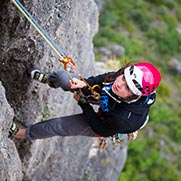


Which belay system should be used to belay a leader directly off the anchor on a multi-pitch route?
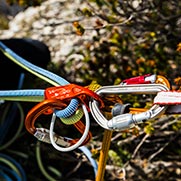
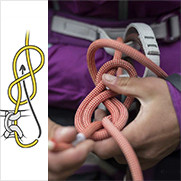
In specific cases when belaying the leader directly off the anchor (e.g. significant weight difference, risk of falling at the start of the pitch), the Munter hitch is the most commonly used method. The REVERSO may also be used, but requires great vigilance when leaving the belay. This technique should only be used on fixed-point belay anchors.
Warnings
- Carefully read the Instructions for Use used in this technical advice before consulting the advice itself. You must have already read and understood the information in the Instructions for Use to be able to understand this supplementary information.
- Mastering these techniques requires specific training. Work with a professional to confirm your ability to perform these techniques safely and independently before attempting them unsupervised.
- We provide examples of techniques related to your activity. There may be others that we do not describe here.
To learn more about belaying the leader directly off the anchor, see the technical tip “Building a belay anchor and belaying on a multi-pitch route equipped with fixed anchors.”
Contents
1. Munter hitch
2. REVERSO: vigilance when leaving the belay
3. GRIGRI, GRIGRI + and NEOX are not designed for this use
1. Munter hitch
In the field, the Munter hitch is mainly used. Simple and versatile, it works both when leaving the belay and throughout the pitch.
When belaying with a Munter hitch, the sleeve on the carabiner can be unscrewed by friction from the rope, if it is in contact with the carabiner gate.
2. REVERSO: vigilance when leaving the belay
We note that the REVERSO is also used for this purpose. While it allows for smoother belaying throughout the pitch, great vigilance is required when leaving the belay.
Special case with the REVERSO, when leaving the belay: mandatory braking carabiner
The use of a braking carabiner with the REVERSO enables the belayer to stop a lead fall directly onto the belay before the next solid point is clipped. Belaying is less smooth when using a braking carabiner.
Once one or more solid points have been clipped by the leader, the braking carabiner can be unclipped for smoother belaying.
In this situation, a quickdraw must NOT be used as a redirect point, as a substitute for a braking carabiner.
Before a solid point is clipped on the pitch, the belayer cannot stop a lead fall with the REVERSO alone.
3. GRIGRI, GRIGRI + and NEOX are not designed for this use
GRIGRI, GRIGRI + and NEOX were not designed for belaying a leader directly off the anchor. The main risks of this use are:
- risk of pressure on the cam when the leader falls (risk of negating the blocking action on the rope),
- no energy absorption due to rope slippage in the belay system (higher loads on the anchor and the climber),
- difficulty in quickly giving slack to the leader with GRIGRI and GRIGRI+.

