By David Parrot
It feels important to write these final words about this expedition. I'm not exactly sure what makes me sad: turning the page, leaving this country without knowing whether I'll ever return, or perhaps imagining that this might be Jean-Paul's last expedition. At 75 years old, it's incredibly courageous.
Our story begins in France, with a finger pointing to a spot on a map. Using his stereoscopic magnifying glass, Jean-Paul spots a tiny black dot on an aerial photograph. What he's pointing to is more than a geological feature—it's the adventure we're about to embark on. Without him, what would we know about this limestone massif, lost in the middle of the Pacific, in Papua New Guinea?
Three flights later, I'm reunited with humidity and familiar scent of this country that left such a lasting impression on me during my first expedition in 2014. After a few days of preparation in Kokopo, we have to catch a boat to Palmalmal. But this year, the sea is too rough, and no departures are allowed. We wait a few extra days, taking the opportunity to climb the active volcano within the caldera and explore the surrounding waters.
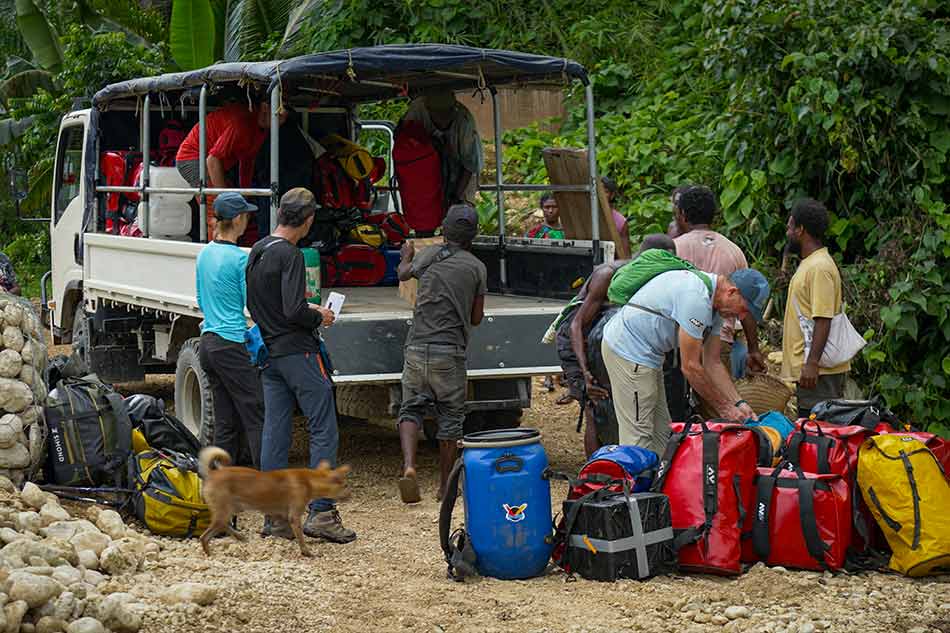
Transporting equipment with the help of locals before setting up base camp deep in the forest..
When we arrive, the long logistical phase begins: unloading 80 packages, securing the necessary permits, and organizing the transport of equipment to the village of Rurai. Then, at last, comes the hike into the forest, where we establish our base camp at an elevation of 1,200 meters.
For several weeks, base camp becomes the expedition's central hub.
The expedition can finally begin. Split into several teams, we continue exploring the Beam of Light cave system discovered in 2023 while surveying new valleys in search of promising sinkholes.
But the terrain and conditions are demanding. We push through dense forest, endure constant humidity, treat injuries before they become infected, and accept uncertainty. The days pass in a cycle of surveying, exploration, and disappointments. After three weeks of effort, several kilometers of surveyed passages, and numerous discoveries, we still haven't found the vast cave system we'd been dreaming of.
Then, almost at the very end of the expedition, everything changed.
Every new valley we survey may reveal a promising sinkhole... or another disappointment.
In a valley south of camp, we discover a new sinkhole. Initially cautious, Cédric keeps quiet about what he sees at the bottom of the first shaft. The next day, equipped with more ropes, we return to explore.
Before long, one gallery leads to another: meanders, dry potholes, shafts, and beautifully sculpted passages carved through magnificent white limestone. After 800 meters of exploration and 140 meters of depth, we're forced to stop because we've run out of equipment. But this time, something feels different.
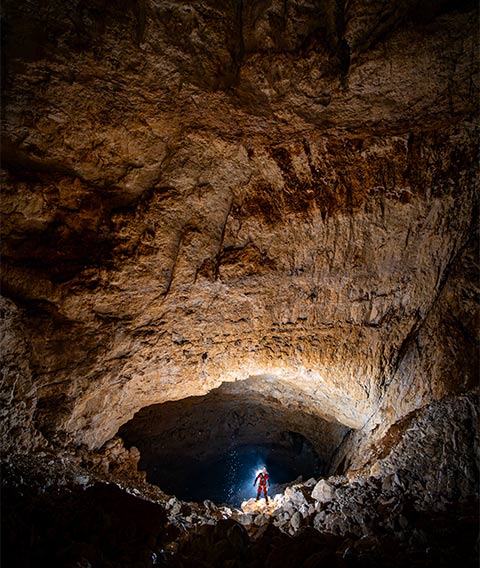
On our next descent, the sinkhole gradually reveals its true scale. The scenery becomes increasingly spectacular: shafts beneath waterfalls, crystal-clear pools, vast passages, and immense underground chambers. Then we reach an enormous chamber where the river disappears into the darkness. Just days before our departure, we've finally found what we were looking for.
At 75, Jean-Paul continues to inspire explorers with his vision, curiosity, and ability to imagine the unknown.
On our final exploration, we descend into this gigantic chamber. A crystal-blue lake fills the center of the cavern while several streams of water cascade from the ceiling.
The cave network continues beyond the chamber, leading us to a magnificent underground river. Carried by the excitement of discovery, we press on until a sump abruptly brings our progress to an end. Are we disappointed?
Perhaps, a little. But that's not what matters most.
Without a dream, this expedition would never have existed. And if, at 75 years old, Jean-Paul still dreams over a map and an aerial photograph, then it's up to us to keep dreaming alongside him.