



Using a single ascender?
A single ascender is not trustworthy; it is recommended to use two ascenders together and/or to use a backup belay system.
Warnings
- Carefully read the Instructions for Use used in this technical advice before consulting the advice itself. You must have already read and understood the information in the Instructions for Use to be able to understand this supplementary information.
- Mastering these techniques requires specific training. Work with a professional to confirm your ability to perform these techniques safely and independently before attempting them unsupervised.
- We provide examples of techniques related to your activity. There may be others that we do not describe here.
1. A single ascender is not trustworthy
Trusting the belay to a single ascender in motion on the rope is risky.
There is a risk of the ascender coming off the rope:
Accidental opening of the safety catch is possible while ascending.
There is a risk of the ascender slipping on the rope:
Excessive mud or ice on the rope, holding the cam open due to poor hand positioning, foreign objects interfering with the cam (branches, pack straps or clothing), worn teeth...
There is risk of disconnecting the ascender’s lanyard, if the carabiner opens (rubbing).
Note:
Breaking strength is not an issue when a single ascender is used by one person.
All of the certification tests, and Petzl’s internal tests, are done on a single ascender.
Note:
When a ascender is on the rope and loaded, it is nearly impossible to cause it to disengage or slip. It’s when the ascender is unloaded and/or moving on the rope that there is a risk of slippage or detachment from the rope.
2. Differences between a ventral ascender and a ascender on a lanyard
Ventral ascender
The ventral ascender is connected directly to the harness without extension. Its stable position allows for good rope glide.
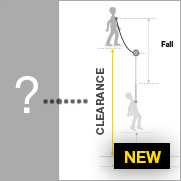
With a minimum of precautions, the user can ensure that a loop of slack is not created while progressing, thus maintaining a very low potential fall distance.
Ascender on a lanyard (or hand ascender)
A lanyard offers more freedom of movement to the user, who can mistakenly find themself above the ascender, or with a slack lanyard. This creates the potential for a free fall. As with the ventral ascender, one must also monitor the tension in the rope between the ascender and the anchor. Any loop of slack is dangerous.
Note:
The risk of falling on a slack lanyard is partly covered by the ascender standards.
The EN 12841 type B standard (ascenders for work): fall test on a dynamic lanyard, ascender on a low stretch kernmantle rope at 1 m from the anchor. Test using the mass marked on the ascender (140 kg for ASCENSION, BASIC, CROLL on compatible rope diameters greater than 10 mm).
EN 567 standard (ascenders for sport): no fall test.
Petzl’s internal tests complement the requirements of the standards by being based on realistic usage scenarios.
These tests help ensure that the ascenders do not tear the rope under the most unfavorable conditions (fall distance equal to the lanyard length, 1 m from the anchor, 80 kg dummy, ropes of compatible diameters).
3. Different modes of ascender use
Rope ascent
The user is hanging on a progression rope.
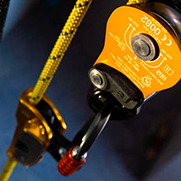
The recommended rope ascent system includes a ventral ascender (CROLL) and a ascender on a lanyard (BASIC, ASCENSION).
The main risks occur at particular moments, when attaching / removing the ascenders: start of the ascent, passing a knot, passing an intermediate anchor, arriving at the anchor station.
As a single ascender is not trustworthy, it is recommended to use two ascenders, both attached to the harness.
Progression along a fixed rope
The user has their weight on their feet, using one or more ascenders for self-belay and as an aid to progression.
The user has their hands free to slide the ascenders along the safety rope, in order to always keep slack out of it.
If there is a low probability of a fall, using a single ascender is possible; the user must always keep slack out of the rope between the ascender and the anchor.