



Crevasse rescue no. 1: transferring the victim’s weight to an anchor
Once the fall has been arrested, the person on the surface holds the victim by acting as a counter-weight. Rapidly creating an anchor allows unloading of the victim’s weight to perform the rescue.
Warnings
- Carefully read the Instructions for Use used in this technical advice before consulting the advice itself. You must have already read and understood the information in the Instructions for Use to be able to understand this supplementary information.
- Mastering these techniques requires specific training. Work with a professional to confirm your ability to perform these techniques safely and independently before attempting them unsupervised.
- We provide examples of techniques related to your activity. There may be others that we do not describe here.
1. Creating a reliable anchor: ice axe or ski buried in the snow, or an ice screw in the ice.
Connecting a sling to the anchor, while minding the direction of pull toward the victim.
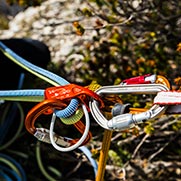
2. Install the MICRO TRAXION on the rope in the direction of hauling: it locks when pulled toward the anchor, and slides when moved toward the victim.
3. Connect the MICRO TRAXION to the anchor sling with a symmetrical locking carabiner.
Extend the sling to its maximum length while sliding the MICRO TRAXION on the rope toward the victim.
4. Gently release the tension of the rope on the harness, to transfer the load to the MICRO TRAXION
Be careful to avoid jerky movements at this time, which would weaken the anchor.
Verify that the anchor is holding well under load.
Untie the rope from the harness and free the chest coils, while remaining tied in to the end of the rope.
5. The victim is now held only by the anchor; the rescuer is able to move freely.
