Industrial protective helmet: New standard EN 397: 2025
The EN 397: 2025 standard marks a major change in the protection provided by industrial helmets, simplifying the regulatory framework and offering requirements adapted to the work situations of industrial professionals. It replaces the EN 397: 2012 standard.
Updated November 23, 2026
1 / What is different?
Up to now, Petzl industrial protective helmets were certified using the EN 397: 2012 Industrial helmet standard and the EN 12492: 2012 Climbing and mountaineering helmet standard. The latter covered risks related to use at height.
The EN 397: 2025 standard now includes new requirements related to use at height. The EN 12492 standard is no longer necessary for this type of helmet.
The EN 397: 2025 standard is now divided into two types: 1 and 2.
The main changes are listed below:
The standard also includes new optional requirements, such as electrostatic properties, enhanced day and night visibility, penetration resistance on the sides of the helmet, or resistance to ignition (molten metal).
The compatibility of accessories listed in the Instructions for Use must be demonstrated.
The lateral deformation tests have been removed.
2/ What is the deadline for implementing this new standard?
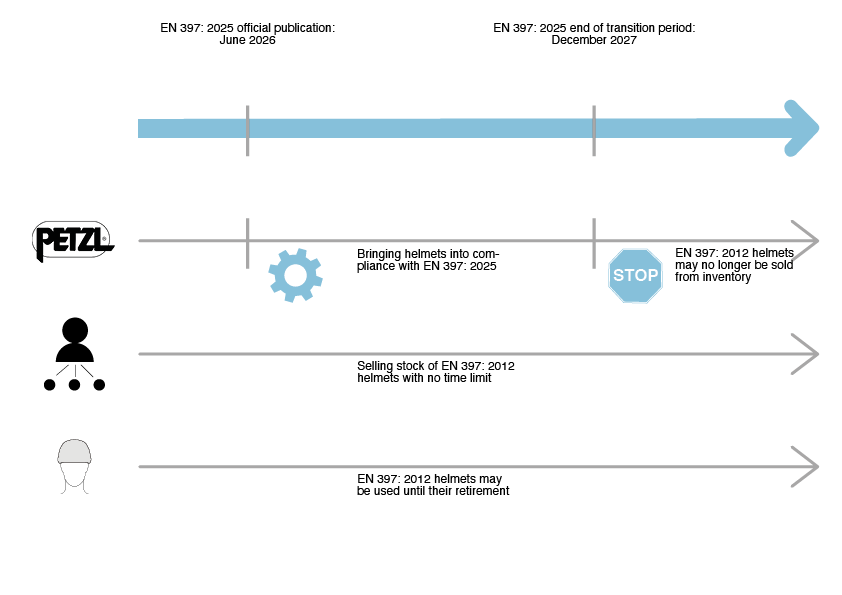
- For manufacturers, the publication of a new version of a standard imposes legal deadlines for ensuring product compliance. Starting on the date the standard is published in the official journal of the EU, June 12, 2026 for the EN 397: 2025 standard, the manufacturer has 18 months to comply, up to the End of transition period date (December 2027).
After the transition period ends, the manufacturer can no longer sell helmets from its inventory that do not meet the new requirements of this standard.
- Retailers can continue to sell their stock, even after the transition period ends.
- Users may continue to use a helmet certified to EN 397: 2012 until it is retired, in accordance with its Instructions for Use.
3/ When will Petzl helmets be certified to this new standard?
Although the regulatory framework does not require immediate compliance, we want to respond as quickly as possible to our customers’ needs with products that meet the requirements of the new EN 397: 2025 standard.
To do this, we plan to launch the VERTEX / VERTEX HI-VIZ and VERTEX VENT / VERTEX VENT HI-VIZ helmets, certified to the new EN 397: 2025 standard, by January 2027 for the VERTEX helmets and by April 2027 for the VERTEX VENT helmets.
The planned certifications for the two helmets are as follows:
|
VERTEX certified to the new EN 397 standard |
VERTEX VENT certified to the new EN 397 standard |
|---|---|
|
EN 397: 2025 Options: Removal of EN 12492 and UIAA partial certification |
EN 397: 2025 Options: Removal of EN 12492 and UIAA partial certifications
|
Non-European certifications remain unchanged
STRATO/STRATO HI-VIZ helmets will also be certified to the new EN 397 standard by February 2027. However, the STRATO VENT will not receive this new certification.
4 / What changes have been made to the helmets to enable compliance with the new EN 397: 2025 standard?
The Instructions for Use and labels will be updated to meet marking requirements.
The VERTEX VENT ventilation system will be updated to meet the new requirements on penetration through the ventilation holes
Products Mentioned In This Article


Pro universe
$124.95